ChatGPT Ads for European Brands: Pricing, GDPR & Media Mix
Your customers are already asking ChatGPT what to buy. Since August, ChatGPT Ads have let brands in 31 European markets pay to join the conversation.

Let’s start with the short answer. ChatGPT Ads are contextual ads shown to people on ChatGPT’s Free and Go plans, right inside their conversations. They launched in Europe in August 2026 and cost roughly €23 to €55 per thousand impressions, or €3 to €5 per click. They run on a two-tier consent model built to satisfy the GDPR, and they belong in your media plan next to search and retail media, not social. A sensible first test is 3 to 5 per cent of your performance budget for one quarter.
Confused much?! Well, that’s a lot to take in. We’ll go through it piece by piece.
First, some context. For twenty years, digital advertising fitted on the back of a napkin. People searched, so you bought Google. People scrolled, so you bought Meta. Everything else was a insignificant.
Then people started asking instead. Somewhere in Porto this morning, someone asked ChatGPT which espresso machine to buy for a small flat. She didn’t type four keywords. She gave it a budget, described her cramped kitchen, made her feelings about coffee pods very clear, and waited for a recommendation.
Plenty of people shop like this now, whether it’s for a holiday, a mortgage or a wedding venue. Until this summer, no brand in the EU could pay to be part of those conversations. Now it can. Since late August, a clearly labelled sponsored box can appear beneath that answer in 31 European markets, following the UK, which went first in June. It reached Europe later, for very European reasons, and it arrived just as search and social keep getting more expensive.
So the real question isn’t whether ChatGPT Ads matter. It’s what they cost, whether your data protection officer will sign them off, and which budget should pay for them.
No more searching; here are the answers, starting with how we got here.
How did ChatGPT Ads arrive in Europe?
ChatGPT Ads came to Europe in three steps:
- A US-only pilot in February 2026.
- A self-serve launch in May.
- A rollout across 31 European markets in August 2026.
Yes, this is still kind of fresh.
For years, OpenAI insisted it would never sell advertising. Then, on 9 February 2026, it quietly started. So much for that. The first test ran only in the United States, only on the Free and low-cost Go plans, and only for invited brands willing to commit around €185,000. The reasoning was simple enough: running a fast, free assistant for hundreds of millions of people “requires significant infrastructure and ongoing investment”says ChatGPT. It’s as if to say: if the subscriber doesn't pay for the electricity, the advertiser will.
Things moved quickly from there. By May, any US business could buy ChatGPT Ads through a self-serve Ads Manager with no minimum spend. Canada, Australia, New Zealand, Mexico, Brazil, Japan and South Korea followed over the next few months, and the UK went live ahead of the rest of Europe. Then, from 18 August, OpenAI switched on 31 more European countries in one go, with self-serve access opening on 31 August.
All of this happened as ChatGPT passed one billion monthly active users. The audience was already there. The ads were simply the last piece of furniture to arrive.
How do ChatGPT Ads work?
Forget most of what you know about buying media. There are no keywords to bid on, no audience segments to build and no feed to interrupt.
ChatGPT Ads are matched to whatever the conversation is about. They only appear for Free and Go users, and they’re always kept separate from ChatGPT’s answer.
Three things set them apart.
1) Placement is contextual, not keyword-based. There’s no search term to bid on. The system reads what the conversation is about and shows a matching ad. Ask about espresso machines and you’ll see espresso machines. Ask about a cheap weekend in Seville and an airline might appear. Advertisers never see the conversation itself, only aggregate impressions, clicks and conversions.
2) The advert sits outside the answer. OpenAI says sponsored content has no influence on what ChatGPT tells you: “Ads do not influence the answers ChatGPT gives you. Answers are optimized based on what’s most helpful to you. When you see an ad, they are always clearly labeled as sponsored and visually separated from the organic answer”. Ads are always labelled as sponsored and visually separated from the answer. In other words, the answer stays the answer, and the ad is a labelled box underneath it. Whether users will keep believing that over time is a fair question, but that’s how it’s designed.
3) Paid subscribers see nothing. Anyone on Plus, Pro, Business, Enterprise or Education gets an ad-free experience. Your audience is the Free and Go crowd, which in Europe is most users and, on average, the more price-conscious end of the market. That should shape both your creative and your offer.
Here’s a simplified version:
- Geo-targeting
- Custom audiences
- Conversion optimisation
- An OpenAI Pixel
- A Conversions API
- Third-party measurement partners
Ads never appear for users under 18, and they’re kept out of sensitive conversations about health, mental health and politics.
What does the ad actually look like?
You get a single sponsored card directly below ChatGPT’s answer. It shows your brand name and favicon, a headline of up to 24 characters, a description of up to 48 characters, a square image and a link. One card per response, never more. OpenAI calls the principle behind this “answer independence”: the ad never appears inside the answer, and no amount of money will get ChatGPT to recommend you in it. Retailers also get Product Spotlight ads, which work a bit like a shopping carousel with the sponsored card front and centre.
Targeting runs on what OpenAI calls context hints. Instead of bidding on “project management software”, you describe the conversations you want to be part of: a founder comparing tools for a remote team of ten, say, or an operations lead who’s outgrown a spreadsheet. The system reads the whole exchange, not just the last message, and decides whether your ad belongs there.
It’s the closest advertising has ever come to the moment someone asks a trusted friend for a recommendation. Not before, while they’re idly scrolling. Not after, once they’ve made up their mind. Right then.
How much do ChatGPT Ads cost in Europe?
Before we get to the money, it’s worth being clear about who you’re paying to reach.
Who you’ll actually reach?
As mentioned, these ads only appear to logged-in adults on the Free and Go plans. Everyone on Plus, Pro, Business, Enterprise or Education sees nothing.
That’s a bigger audience than it sounds. More than a billion people use ChatGPT every week, and most estimates put over 80 per cent of them on the free tier. According to OpenAI’s DSA report, ChatGPT’s search function averaged 159 million monthly users in the EU over the six months to March 2026. And at Cannes Lions this summer, OpenAI’s head of ads said roughly one in five conversations has direct commercial intent. That’s a lot of people asking which laptop, which hotel, which accountant.
But it is a specific audience, and you should be honest with yourself about who’s missing. The finance director with a Business seat is invisible to you. Paid subscribers tend to be wealthier and more engaged online, and the only way to reach them inside ChatGPT is to be recommended in the answer itself. Hold that thought; we’ll come back to it.
What’s the price?
No for money, which is more reasonable than you might think. There’s no minimum spend for self-serve accounts, and OpenAI didn’t announce one for the European launch either. It also hasn’t published European prices. Because ChatGPT Ads run on a relevance-weighted, second-price auction, demand will set them. Your best guide is early US data converted to euros: CPMs fell from around €52 at launch to as low as €22 by April, and OpenAI suggests starting with a maximum bid of roughly €2.60 to €4.30 per click.

A relevance-weighted, second-price auction means the most relevant ad can win even with a lower bid, and the winner usually pays less than their maximum. For context, early ChatGPT CPMs sat well above Facebook and Instagram and close to LinkedIn’s. That tells you what OpenAI thinks it’s selling: not scrolling attention, but attention at the moment of decision.
The practical takeaway is that the doors are opening. The February pilot asked for six-figure commitments; now Ads Manager is rolling out to businesses of every size. Our suggestion: a test of €3,000 to €10,000 over three or four weeks is a reasonable way in.
And right now, European auctions are thin. Early bidders in the US and Brazil picked up attention cheaply while their competitors were still filling in the verification form.
How do ChatGPT Ads get past the GDPR bouncer?
Through a two-tier model. Contextual ads run on legitimate interest, while personalised ads need explicit consent and are only now arriving in the EU.
Your data protection officer will skip straight to this bit, so here’s the door policy.

Tier one, contextual (live since August)
Under Article 6(1)(f) GDPR, OpenAI uses:
- The current conversation topic
- Approximate city-level location
- Device type
- Time of day
- Language
No profile is built, no history is consulted and no opt-in is needed.
Tier two: personalised (on its way)
This tier uses current and past chats to work out what someone’s interested in, so it needs explicit consent. As of early October 2026, OpenAI says it’s coming “soon” for European users. Saying no doesn’t make the ads disappear; you simply stay on contextual ones. The only way to remove ads entirely is a paid plan. Plus costs in the low-to-mid €20s a month in most EU markets, VAT included, while Go, at around €8 to €9, still shows ads.
What the regulators are watching
German state data protection authorities have raised concerns about personalised chatbot advertising. Their worry is that people treat these tools as confidants, and that their mood can be read in real time. Ireland’s Data Protection Commission, OpenAI’s lead regulator in the EU, said nothing publicly when the ads went live. That silence is worth watching rather than reading as approval. Meanwhile, the EU AI Act restricts manipulative techniques, and the Digital Services Act may yet classify ChatGPT search as a very large platform.
What it means for you
None of this creates new legal obligations for advertisers, and your own consent and data practices remain your responsibility. Expect the personalised tier to be smaller and slower to arrive in Europe, and expect early European results to come mostly from contextual ads. Plan for that, and you won’t be disappointed.
Where ChatGPT fits in your media mix (spoiler: it isn't Google)
The lazy take is that ChatGPT Ads are a search product, so the money should come out of the search line. That’s wrong on both counts, and acting on it will cost you twice.
Let’s jump in. ChatGPT Ads sit between search and retail media on the intent ladder: further down the funnel than social, and richer in context than search. Fund them from your performance budget, run them after your awareness channels have done their work, and measure them with holdouts, not last-click.
Most coverage skips this question entirely. The better answer is to work out which rung of the ladder they occupy, because it’s a new one.
1) Three platforms, three moments
Google catches the searcher: someone who knows what they want, has typed it in and is ready to act. It’s the finest demand-capture machine ever built. Meta finds the dreamer: someone who hasn’t started looking yet but fits the profile of a person who might. It creates the demand for Google to catch.
ChatGPT reaches a third character altogether. Call them the decider. They know what they need but aren't sure which option to choose. So, they compare choices in simple terms, ask follow-up questions and weigh up trade-offs. They’re close to deciding. That person isn’t typing “best CRM small business” into a box. They’re describing their business to a machine and asking what it would do.
You can see it in the queries. A search is a fragment: three words and a hope. A ChatGPT conversation is a brief, complete with the budget, the constraints and the thing they tried last year that didn’t work. No keyword tool has ever seen that much intent in one place.
2) Think with intent, not channels
Picture your mix as a ladder of intent. Display and video at the top reach people who aren’t looking for anything. Social catches interest mid-scroll, usually a long way from a purchase. Search captures a specific, typed-in need. Retail media sits at the shelf, nudging a decision that’s already been made.

A ChatGPT conversation sits between search and retail media, with more context than either. A Google query might be four words. A ChatGPT exchange is a paragraph of constraints: “under €400, small kitchen, no pods, what about the Italian brands?” That’s a far stronger signal of intent. It’s why the first movers, Target, Williams-Sonoma, Albertsons and The Knot, treated it as retail media’s conversational cousin rather than a display placement. Agencies brought in Adobe, Audible, Ford and Mazda on the same logic.
So the first rule is simple: don’t put it next to social. Put it alongside search and retail media, and expect it to behave like them.
3) The middle of the funnel has gone unpaid for years
Most media plans pay for the top and the bottom of the funnel and leave the middle, where the decision actually gets made, empty. That gap used to be filled by review sites, comparison articles, a Which? report and a friend who bought one last year. Brands could only influence it indirectly, through PR, affiliates and content, none of which they could buy or measure cleanly.
These days, that middle is increasingly a conversation with an AI. ChatGPT Ads are the first paid way for brands to take part without pretending to be the answer. That’s the whole proposition. Not more reach, not cheaper clicks, but a paid presence at a moment that’s never had one.
4) Where should the budget come from?
Take it from the pot that pays for search and retail media, not from brand or social. That way you’re comparing like with like: cost per qualified visit, per lead, per sale. Pull it from social instead and you end up judging a decision-stage channel against an awareness-stage one, which tells you nothing useful.
For a mid-sized European advertiser, 3 to 5 per cent of digital performance spend is a sensible starting point, ring-fenced for a full quarter. On a monthly performance budget of €50,000, that’s €1,500 to €2,500. Enough to get a real signal, not enough to upset anything that’s already working.
5) Sequence it, don't isolate it
By the time someone is comparing options in ChatGPT, they’ve usually come across your brand already. So don’t write creative that introduces you from scratch. Assume they know roughly who you are and give them a reason to pick you: a price, a delivery promise, something that beats the alternative they just mentioned. Specific claims beat slogans every time.
Keep your social and display activity running alongside it, not in its place. Think of ChatGPT Ads as the step that turns the warmth those channels built into a decision.
6) Why it isn't just search with extra steps
Google isn’t standing still. AI Mode now has its own ad formats, including Conversational Discovery Ads, which build the creative around how the question was worded, and a Direct Offers pilot with native checkout. The catch is that you can’t buy any of them on their own. They come bundled inside Search and Performance Max, they take a share of your budget, and it’s hard to tell what they actually delivered. Meta has gone a similar way: since December 2025, conversations with Meta AI have fed targeting on Facebook and Instagram, but you never see that signal as a buyer.
ChatGPT is the only one of the three you can buy deliberately, with its own budget, its own creative and its own line in the report. Perplexity, meanwhile, shut down its advertising experiment in February. So if you want to show up in a genuine conversation about what to buy, and actually know what you got for your money, ChatGPT is currently the only game in town.
7) How to slot it in
Treat it as a fourth line in the plan, not a raid on your search budget. The frameworks doing the rounds among agencies suggest putting somewhere between 5 and 15 per cent of paid budget into ChatGPT as a test. Whatever figure you land on, don’t starve the channel that captures the demand ChatGPT helps create.
Write for the moment, not the medium. A search ad interrupts a query. A ChatGPT ad appears after an answer the user asked for and, quite often, agreed with. Creative that argues with that answer loses; creative that builds on it wins. And send the click to a page made for someone who’s still comparing, not straight to a checkout built for someone who’s already decided.
Judge it on revenue, not on the dashboard. Platform-reported returns flatter every channel, and here they’re still unproven. Look at what ChatGPT added alongside everything else in the plan over the same weeks. If branded searches on Google go up while your ChatGPT campaign is live, that’s not a coincidence. That’s the channel doing its job further up the funnel.
8) How should you measure ChatGPT Ads?
Use a geo-split or a holdout, and judge the results on cost per opportunity in your CRM, not on the cost per click the platform reports.
The same privacy model that keeps European regulators relaxed also strips out the identity matching you’re used to across Meta and Google. Last-click attribution will undercount ChatGPT when it helps a sale along, and overcount it when it happens to sit next to purchases that were coming anyway. A cleaner test: run it in Spain and Italy, leave France and Germany as the control, and compare the lift. Or add it to your marketing-mix model and give it a quarter. Every new channel looks brilliant on its own dashboard.
9) Paid ChatGPT Ads Vs earned ChatGPT mentions
Buying an ad on ChatGPT is one job. Getting your brand named in ChatGPT’s actual answers is a different one, usually called answer engine optimisation (AEO). That comes down to four things:
- Content quality
- Structured data
- Reviews
- Being present on the sources the model cites
One you pay for, the other you earn. Both belong in a European media plan by 2027, just in separate columns.
The European wrinkle: GDPR, consent and targeting
Europe didn’t get the same version of ChatGPT Ads that America has, and for once, the difference works in the advertiser’s favour.
To satisfy the GDPR, OpenAI built a two-tier consent model. By default, ads are matched only to the conversation in front of the user, plus approximate location, device, language and time of day. No chat history, no stored memories, no profiling across sessions. Personalised ads, which draw on past ad interactions and inferred interests, need a separate, explicit opt-in that users can withdraw at any time. In practice, that means European campaigns are context-first, which happens to be what the platform does best. Advertisers get aggregated performance data and nothing more. Nobody ever sees what a user actually typed.
Naturally, the regulators are watching. The EU AI Act’s enforcement powers kicked in twenty-two days before the European launch. On 31 August, the Commission designated ChatGPT a very large online search engine under the Digital Services Act, which brings independent audits and, eventually, a public repository of every ad shown to EU users. None of this should put you off. If anything, you should be glad the guardrails were built in from day one rather than bolted on after the first scandal.
One practical point: your ad runs in the language of the conversation, and targeting only goes down to country level. A campaign for Munich is a campaign for Germany. Europe is 31 markets, not one, and your creative has to work that way.
Should European brands test ChatGPT Ads now?
It depends, and anyone who tells you otherwise is selling something.
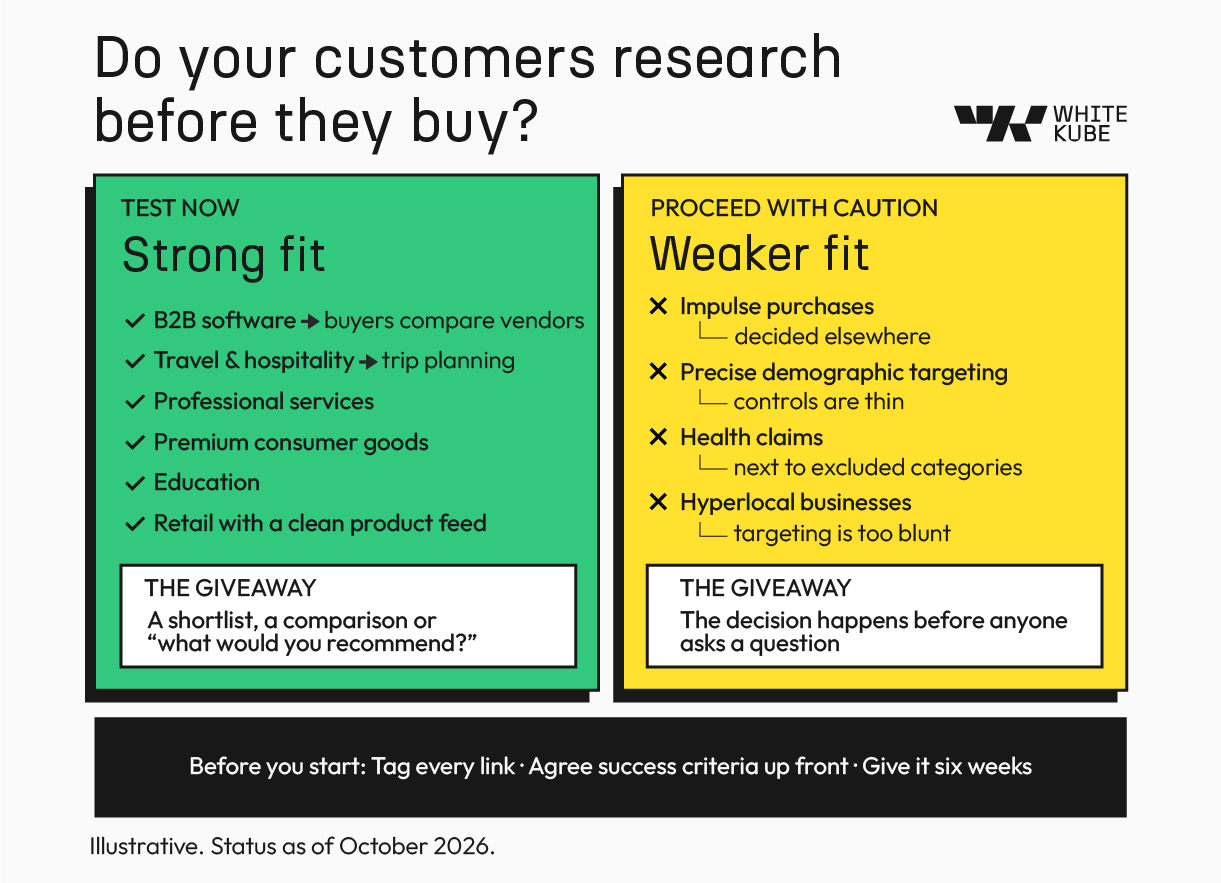
The brands that fit best have one thing in common: their customers do their homework before they buy. Think B2B software, where buyers ask ChatGPT to compare vendors, or travel and hospitality, where trip planning is one of the things people use it for most. Professional services, premium consumer goods, education and retailers with a clean product feed for Product Spotlight ads all belong on the list too. If your sales cycle involves a shortlist, a comparison or someone asking “what would you recommend?”, you should be testing this.
The weaker fits are just as easy to spot. Impulse purchases get decided somewhere else. Brands that depend on precise demographic targeting will find the controls thin. Anything making health claims sits right next to categories OpenAI won’t touch. And for a hyperlocal business, country-level targeting is a very blunt instrument.
Two caveats before you start. First, measurement is still young. OpenAI offers a pixel and a Conversions API, yet some agencies are already reporting clicks in the dashboard that their own analytics can’t explain. Tag every link and give it six weeks before you draw any conclusions. Second, treat the spend as a test, with success criteria agreed up front, not as a budget line you’ll have to defend at the quarterly review. What early movers win is cheap inventory and a head start on learning. Guaranteed returns aren’t part of the deal.
So, yes: as a small, ring-fenced performance test. ChatGPT Ads sit on a new rung of the intent ladder, between search and the shelf, with more context than either. The pricing reflects decision-stage intent, and Europe’s privacy rules will keep the personalised side modest for a while. Treat them as a performance channel, fund them like one, measure them like a grown-up, and keep the first test small enough that you’d happily switch it off.
Chances are, you won’t want to.

RELATED

How Marketers Should Rethink Measurement in a Privacy-First World


